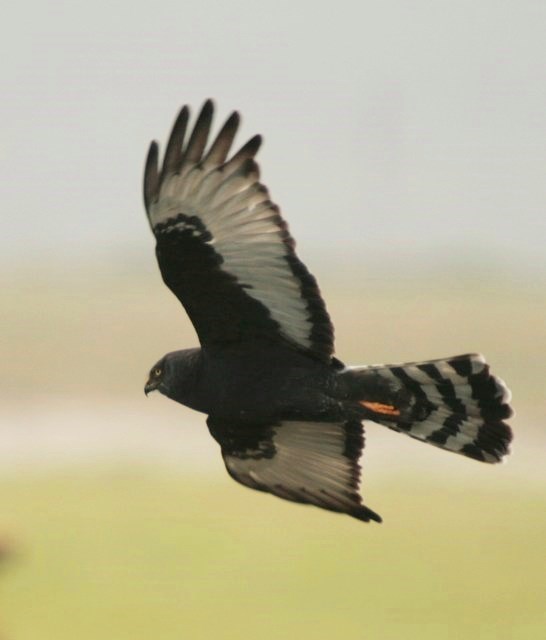
Quick Facts
Facts sourced from Wikidata (CC0).
Conservation Status
Conservation hubFaces a very high risk of extinction in the wild.
The Black Harrier is threatened by habitat loss due to agriculture and development, as well as collisions with power lines. While specific recovery programs are limited, ongoing habitat protection initiatives in its range indirectly benefit the species. Responsible safari tourism helps by funding conservation efforts and raising awareness, providing economic incentives for local communities to protect the natural habitats these birds rely on.
The black harrier is a medium-sized African harrier whose range extends from South Africa to Botswana and Namibia. It has a wingspan of 105–115 cm (41–45 in) and a body length of 44–50 cm (17–20 in). When perched, this bird appears all black. However, in flight, a white rump and flight feathers becomes visible. Its morphology is comparable to that of other harriers, with narrow wings, a slim body, and a long tail. Male and female plumages are similar, while juveniles have buff underparts and heavily spotted breasts.
Description adapted from Wikipedia, CC BY-SA 4.0.
Where to Find
Top parks for Black Harrier. Sightings recorded in 19 safari areas total.
Best Safari Destinations
Loading safari destinations...
Ready to see Black Harrier in the wild?
Use our tools to find the right park and plan your trip.